Bioinformaticians' Tale: From Pipeline Plumber to Architects of Agentic Bot-Labs
hot take
tech
bioinformatics
Bioinformaticians' Tale: From Pipeline Plumber to Architects of Agentic Bot-Labs
This is my early 2026's hot-take on the future of bioinformatics: The "Bioinformatics Bottleneck" is dissolving. As AI agents move from writing boilerplate code to orchestrating entire experimental loops, the role of the human scientist is shifting from "pipeline builder" to "architect of discovery."
The Classical Era: Curators of a Digital Cabinet of Curiosities
In the 17th century, the Natural Philosopher labored over copperplates and jars of formaldehyde to catalog the known world in "Cabinets of Curiosities." In the classical era of bioinformatics, we were curators of a digital "Cabinet of Curiosities." We spent decades cataloging the nuances of package dependencies, the R/Python debate, and the good-vs-ok-vs-ugly debate of unorchestrated benchmarks.
 A 17th-century Wunderkammer—the precursor to modern scientific data repositories.
But as we enter 2026, the "Pipeline Plumber"—the researcher whose primary value lies in connecting Tool A to Tool B—is being replaced by the Agents. Or are they?!
For the last decade, the life of a bioinformatician has been defined by the pipeline. Whether it's scRNA-seq integration, normalization, or batch effect removal, much of the daily grind involves stitching together existing tools (the Scanpy vs. Bioconductor wars) to ensure data flows from sequencer to visualization.
But the "Agentic Era" is changing the math. AI agents are no longer just autocomplete for Python; they are becoming proficient at defining workflows, managing dependencies, and enforcing best practices better—and faster—than humans.
If an agent can handle the boilerplate, what is left for the bioinformatician?
The Dissolution of the Pipeline Plumber
Eliminating the "Boilerplate"
Historically, the first 60–80% of any bioinformatics project had nothing to do with a hypothesis. It was about overcoming the friction of fragmented tools. Bioinformatics was built on "wrappers." You would take a tool written in C++, wrap it in a Perl script, and then try to visualize the output in R.
The "boilerplate" was the endless string manipulation—converting a .sam to a .bam, then to a .bed, then to a custom CSV—just so one tool could talk to the next.
 The tangled web of software dependencies and data formats in traditional bioinformatics.
Every new project required the same repetitive ritual:
- QC plots. You'd spend days looking at library sizes, mitochondrial read percentages, and batch effect visualizations. This wasn't "discovery"; it was just making sure the sequencer hadn't lied to you.
- Dependency Hell. Until recently, a bioinformatician's greatest skill was "knowing which version of a library wouldn't break the server." You would spend hours manually resolving
LD_LIBRARY_PATHissues or fighting with broken conda environments.
For years, the field was split by a technical wall:
| The Bioconductor Side (R) | The Scanpy Side (Python) | |---|---| | Great for statistical rigor and established genomic packages | Great for machine learning and scale | | Often slow with massive datasets | Lacked some deep-rooted statistical tools |
The "boilerplate" task here was often re-implementation. You'd find a perfect tool in R, but your pipeline was in Python, so you'd spend a week writing a bridge or porting logic just to get a single normalization step to work. It was a tax on cross-disciplinary collaboration.
This created a "Technician's Trap." Because the boilerplate was so time-consuming, the bioinformatician often didn't have the mental bandwidth to ask why a certain gene was being looked at—they were too busy making sure the pipeline didn't crash because of a memory leak.
The Agentic Era: A New Math
Today, agentic AI is seeming to completely and neatly eliminate that problem. We are entering a phase where the specific language or tool is secondary to the logic of the analysis. Agents can implement complex variational inference models or spatial pathology vision transforms with minimal manual intervention.
However, this automation introduces a new risk: The "Scientific Garbage In, Garbage Out" Trap. As code generation becomes effortless, the volume of noise could skyrocket. The responsibility of the modern bioinformatician is shifting from writing the code to governing the science.
Example: Remedy to the Pain of Benchmarking
I have a confession: The most "scientific" parts of my recent papers were often the shortest to write. The rest of my time? I was a glorified plumber for broken code.
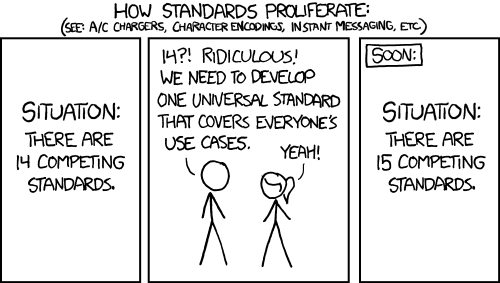 The proliferation of 'standards' and the benchmarking cycle in bioinformatics.
The Purgatory of Comparison
To prove your model's worth, you can't just show it works; you have to show that 20 other models don't work as well. This is where the nightmare begins.
In any other field, you'd pull a library and run it. In bioinformatics, you are performing "Software Archeology." You find a "State of the Art" tool from 2021, but it's a ghost:
- The GitHub repo hasn't been touched in three years
- It requires R 3.4 and a version of LLVM that was deprecated when the iPhone X was new
- The documentation is a single, cryptic README that says "just run the script"
I have spent weeks—literally weeks—fighting with conda environments and LD_LIBRARY_PATH variables just to get a competitor's code to run for one bar chart. It is a massive drain on human potential. We are trained to solve cancer and understand the brain, yet we spend our prime years acting as human wrappers for unmaintained code.
The Light at the End of the Pipeline
This is why I am so obsessed with the rise of Agentic AI and external efforts like Omnibenchmark and Open Problems. I can foresee that we are moving toward a world where the "Benchmarking Tax" is automated away.
Imagine an AI agent that:
- Containerizes legacy code automatically, resolving dependencies in seconds that would take us days.
- Orchestrates the "Neutral Ground," running your new model against a battery of 50 datasets it has never seen before, using metrics you didn't choose.
- Removes the "Gatekeeping," allowing the field to move as fast as the code is written, not as slow as the peer-review cycle.
For those of us who live for the "modeling" part—the math, the physics, the abstraction of complex biology into computable logic—this shift is a liberation.
The 10-Year Outlook: The Robotic Wet Lab
The same "boilerplate" problem exists in the wet lab. PhD students spend weekends performing repetitive tasks that are ripe for automation. In the next 5–10 years, we will likely see the rise of "Closed-Loop" labs, where AI agents not only analyze data but direct robotic systems to conduct the next experiment.
Conclusion: It's Time to Reskill!
As the "middle-man" work of pipeline construction disappears, the field will bifurcate into three critical domains:
1. Mathematical & Physical Modeling
We are moving beyond "black-box" machine learning. To solve complex biology, we need scientists who can abstract biological problems into computable frameworks. This requires deep domain knowledge—think of the transition from simple clustering to complex models like scVelo. The future belongs to those who can translate the "physics" of biology into the right mathematical abstractions.
2. Engineering & Maintenance (Bio-MLOps)
An AI agent can build a workflow, but it cannot yet maintain a product's integrity over time. "Bio-MLOps" will become a core discipline. Understanding where a model fails, managing CI/CD in a scientific context, and ensuring code quality isn't just "functional" but "robust" will be the engineering challenge of the decade.
3. Biological Validation (The Truth Arbiter)
Perhaps the most vital role will be the Validator. In an era where AI can "hack" a result or hallucinate a pathway, the expert human is the final line of defense. We need to define the benchmarks—automated, standardized, and orchestrated—that prove a discovery is real and reproducible.
References
- scverse: The unified open-source framework for single-cell omics analysis in Python.
- Omnibenchmark: A framework for community-driven, continuous, and open benchmarking in bioinformatics (Robinson Lab, UZH/SIB).
- Jinkō by Novadiscovery: Clinical trial simulation platform using AI and virtual patients.
- LangGraph: Multi-agent orchestration framework built on LangChain.
- Ginkgo Bioworks: Biological foundry integrating robotic automation and AI for synthetic biology.
- CellXGene Discover: CZ Science's platform for exploring single-cell RNA-seq data and the Human Cell Atlas.
Tags: hot take, tech, bioinformatics
Rate this post
Applause
Comments