Why Picasso Made 147,000 Things (And Why You Should Too)
creativity
systems
psychology
productivity
Why Picasso Made 147,000 Things (And Why You Should Too)
There's a tension in creative work that nobody tells you about until you're deep in it: the war between wanting to explore new ideas and wanting to only ship "perfect" work.
In machine learning, we call this the exploration-exploitation trade-off. In real life, we call it perfectionism. And it's quietly killing your output.
I've been thinking about this a lot lately—partly because of my own work in research, and partly because I stumbled onto a fact that rewired how I think about productivity: Pablo Picasso produced over 147,000 distinct works in his lifetime. Not sketches tucked in drawers. Catalogued works. Paintings, sculptures, ceramics, prints, drawings.
That's not talent. That's a system.
The Equal-Odds Rule (Or: Why Your "Mediocre" Work Matters)
In 1997, psychologist Dean Keith Simonton analyzed the careers of over 2,000 scientists and artists and discovered something counterintuitive: the probability of creating a masterpiece is statistically independent of how much you've already produced.
Read that again.
It means your next piece has roughly the same odds of being brilliant whether it's your 10th or your 10,000th. The only variable you actually control? How many times you roll the dice.
Picasso's Les Demoiselles d'Avignon—the painting that essentially invented Cubism—required hundreds of preparatory sketches. But he also produced thousands of ceramic plates that critics dismiss as "commercial filler." The masterpiece doesn't exist without the mountain of mediocrity beneath it.
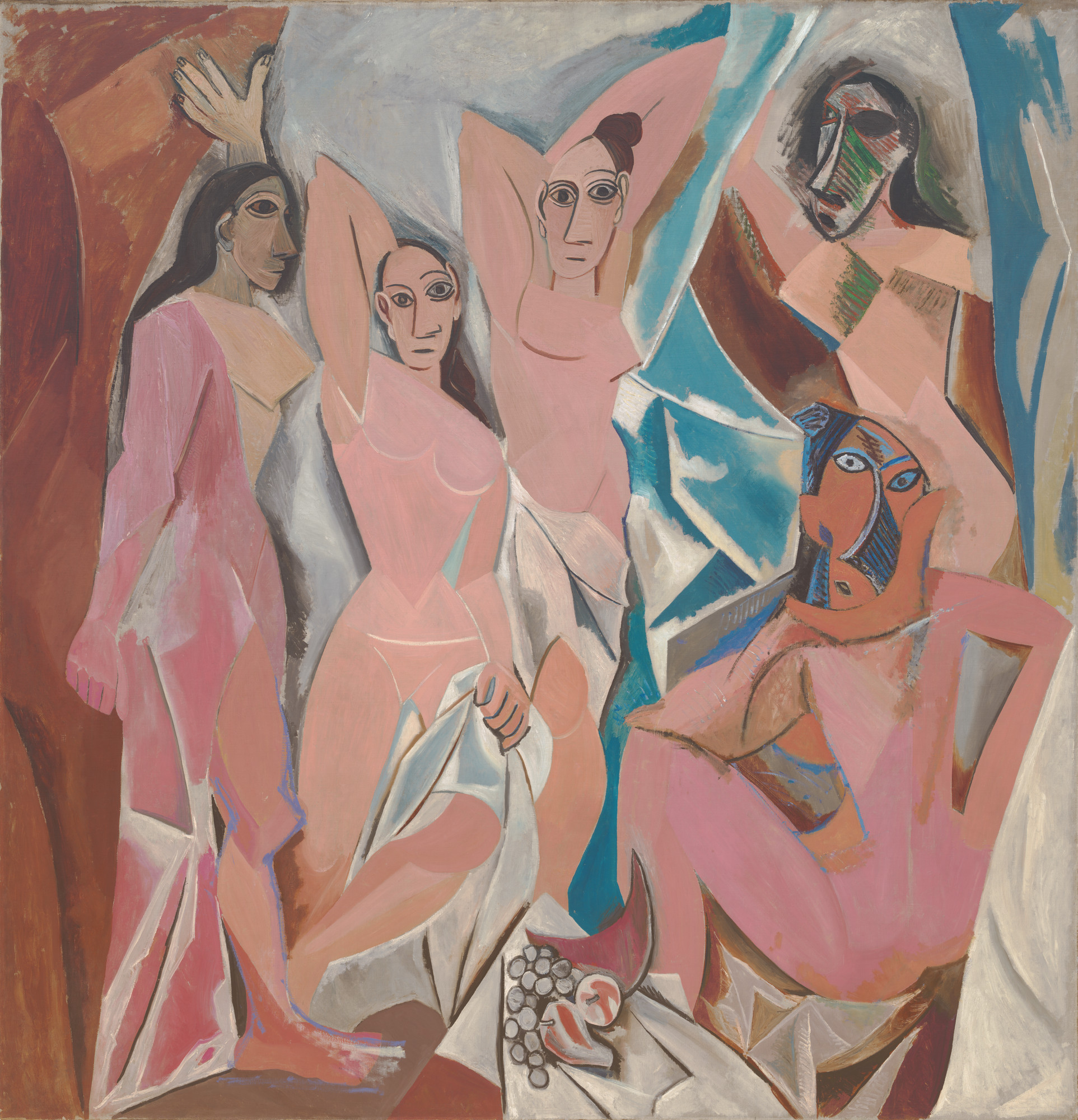 The Signal: Les Demoiselles d'Avignon (1907). A "hit" that required hundreds of preparatory iterations. MoMA Collection
 The Noise: One of thousands of ceramic plates Picasso produced—often dismissed as "commercial filler," but essential to maintaining the volume required for hits to occur. Wikimedia Commons

This is the math most perfectionists get wrong. They try to increase P(H)—the probability of a hit—through endless refinement. But P(H) is largely determined by factors outside your control: timing, luck, what the world happens to need right now. What you can control is n, the number of attempts. And S = n × P(H) doesn't care about your feelings.
 The Long Tail of Creativity: Most output clusters around "average." Masterpieces are outliers that only appear when volume is high enough to reach the tail. Wikimedia Commons

Ego as Cognitive Friction
Ryan Holiday calls ego "an unhealthy belief in our own importance." I've started thinking of it differently: ego is cognitive friction. It's energy lost to heat instead of motion.
Here's how it plays out across three phases:
When you're starting out, ego demands the reputation of being "the best" before the work is done. You visualize the win, you fantasize about the recognition, and your brain rewards you with dopamine—for something you haven't actually achieved. The drive to do the boring, necessary work evaporates. Why grind when you've already mentally collected the trophy?
When you succeed, ego kills the student mindset. You stop experimenting because you're terrified of losing your status. Picasso avoided this trap by constantly resetting—Blue Period, Rose Period, Cubism, Surrealism, Neoclassicism. Each transition was essentially ego bankruptcy: declaring that whatever he'd mastered was no longer the point.
When you fail, ego turns a data point into an existential crisis. If your identity is "The Best," then a mediocre Tuesday isn't just an off day—it's evidence that you're a fraud. The iterative creator sees a miss and moves on. The ego-driven creator sees a permanent stain.
 Mindset Mechanics: Ego-attachment (Fixed) treats failures as identity threats. Process-attachment (Growth) treats them as data points. Wikimedia Commons

The Neuroscience of Resistance
Why does perfectionism feel so heavy? It's not metaphorical. It's an amygdala hijack.
When you set an impossible standard, your brain perceives the task as a threat to your self-image. The amygdala triggers a stress response, flooding your system with cortisol and suppressing your prefrontal cortex—the exact part of your brain you need for creative problem-solving. You're literally fighting your own neurochemistry.
This maps perfectly to the Yerkes-Dodson curve: moderate pressure optimizes performance, but ego-driven pressure pushes you past the peak into anxiety and breakdown.
 The Yerkes-Dodson Law: Performance peaks at moderate arousal. Ego-driven perfectionism pushes you past optimal into the anxiety and breakdown zones. Wikimedia Commons

I've lived both sides of this. Growing up in Iranian Olympiad culture, the ego stakes were crushing—every problem set felt like an identity referendum. The result was performance paralysis and constant self-handicapping. Later, learning German in a low-stakes environment where I genuinely loved the process, I experienced what Csikszentmihalyi calls Flow: self-consciousness disappears, time distorts, and neural efficiency peaks.
Same brain. Completely different outputs.
Mentzer vs. Schwarzenegger: A Study in Two Systems
You can see this dynamic play out in bodybuilding history through Mike Mentzer and Arnold Schwarzenegger.
 Mike Mentzer: High-intensity, low-volume training fueled by a need for logical "perfection." His identity was fused to his theory. Wikimedia Commons

Mentzer developed "Heavy Duty" training—a hyper-logical, low-volume system built on the premise that every set should be maximally efficient. He was obsessed with being right. His ego was fused to the perfection of his theory, which created immense psychological pressure. One suboptimal workout wasn't a data point; it was a refutation of his entire philosophy.
 Arnold Schwarzenegger: High-volume, iterative training fueled by "the pump" and process enjoyment. Psychological flexibility enabled him to reinvent himself across multiple careers. Wikimedia Commons

Schwarzenegger took the opposite approach: high-volume, iterative training. He didn't need every set to be "right." He focused on cumulative load and—crucially—the enjoyment of the process. This psychological flexibility let him move from bodybuilding to cinema to politics without the friction of a fixed identity. He wasn't "Arnold the Bodybuilder." He was Arnold, who happened to be bodybuilding right now.
One of these men won seven Mr. Olympia titles and became Governor of California. The other spent his later years in bitter disputes about training theory.
The Practical Takeaway
The Picasso strategy isn't about lowering your standards. It's about redirecting your optimization energy.
Stop trying to maximize P(H) through over-analysis. That variable is largely out of your hands. Instead, build systems that maximize n—the number of iterations, experiments, and attempts. Lower the stakes on any individual piece. Treat each output as a data point, not a verdict.
The masterpieces will come. They're hiding in the long tail of the distribution, waiting for you to generate enough volume for them to appear.
Your only job is to keep rolling the dice.
References: Simonton (1997), "Creative Productivity"; Holiday (2016), "Ego is the Enemy"; Csikszentmihalyi (1990), "Flow"; Pressfield (2002), "The War of Art"
Rate this post
Applause
Comments